

Streamlining Business Processes with AI-Powered Automation
The Hidden Cost of Manual Processes
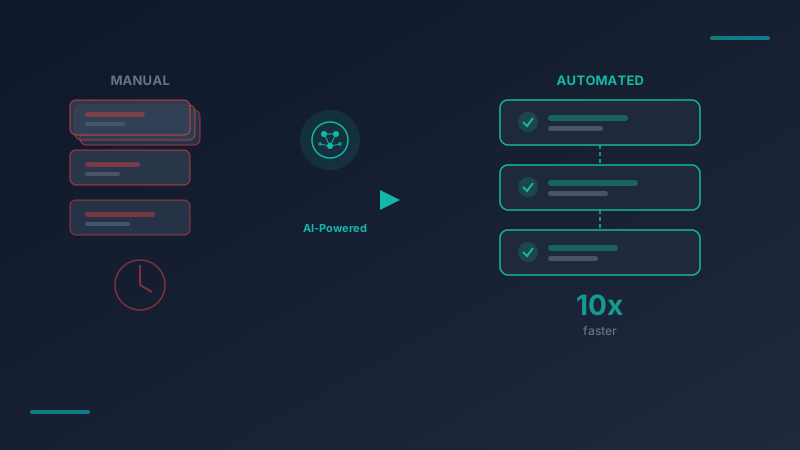
Every business has them — repetitive tasks that eat up hours every week. Data entry, invoice processing, email sorting, report generation. These tasks are not just time-consuming; they are error-prone and demoralizing for the people doing them.
AI-powered automation does not replace your team. It frees them to do work that actually requires human judgment and creativity.
Identifying Automation Opportunities
Start by auditing your existing workflows. Look for processes that are:
- Repetitive — Done the same way every time
- Rule-based — Follow clear if-then logic
- Data-heavy — Involve moving information between systems
- Time-consuming — Take more than 30 minutes per occurrence
Common candidates include invoice processing, customer inquiry routing, inventory updates, appointment scheduling, and report compilation.
Where AI Adds Intelligence
Traditional automation follows rigid rules. AI-powered automation adapts:
Document Understanding
AI can read invoices, contracts, and emails, extracting key information regardless of format. No more creating templates for every vendor's unique layout.
Smart Routing
Customer inquiries get categorized and routed to the right department automatically — not based on keywords alone, but on the actual intent of the message.
Predictive Actions
Based on historical patterns, AI can anticipate needs: reordering supplies before they run out, flagging unusual transactions for review, or suggesting optimal pricing based on demand.
A Practical Example
Consider a hotel's guest communication workflow:
- Guest sends a booking inquiry via email
- AI extracts dates, room preferences, and special requests
- System checks real-time availability
- AI drafts a personalized response with pricing and availability
- Staff reviews and sends with one click
What used to take 15 minutes per inquiry now takes 30 seconds of human review time.
Info
Getting Started
- Map your current processes — identify bottlenecks
- Prioritize by impact — automate high-frequency tasks first
- Start small — pilot with one process before scaling
- Measure results — track time saved and error reduction
- Iterate — refine based on real-world feedback
The businesses that thrive in the next decade will not be the ones with the most employees — they will be the ones that use their people's time most intelligently.
On this page