

Supercharging Web Performance with WebAssembly and C++
When JavaScript Is Not Fast Enough
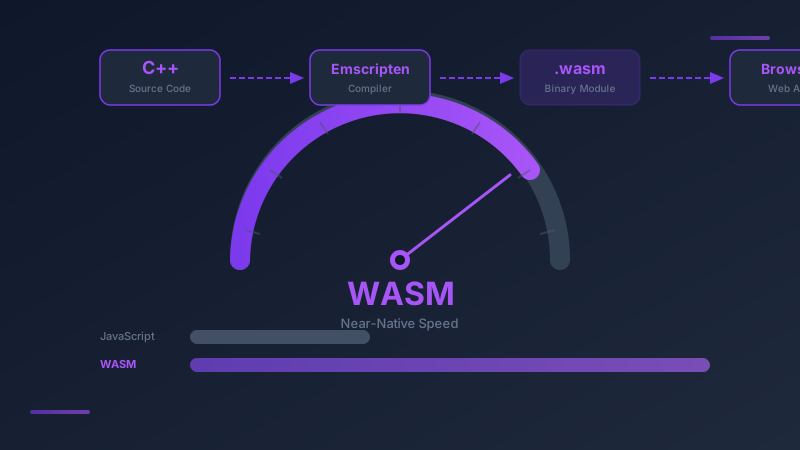
JavaScript is remarkably fast for a dynamic language. But for compute-heavy tasks — image processing, physics simulations, data compression, cryptographic operations — it hits a ceiling. That is where WebAssembly (WASM) comes in.
WASM is a binary instruction format that runs at near-native speed in the browser. And if you already know C++, you can compile your existing code directly to WASM.
The Compilation Pipeline
This produces a .wasm binary and a JavaScript glue file that handles loading and memory management.
Calling WASM from JavaScript
The boundary between JavaScript and WASM is seamless. You pass data in, get results back, and the browser handles the rest.
Real Performance Gains
In our benchmarks for image processing tasks:
| Operation | JavaScript | WASM (C++) | Speedup |
|---|---|---|---|
| Resize 4K image | 340ms | 45ms | 7.5x |
| Apply blur filter | 280ms | 32ms | 8.7x |
| JSON parse (large) | 120ms | 18ms | 6.6x |
These are not synthetic benchmarks — they are from real production workloads.
When to Use WASM
WASM excels at:
- CPU-bound algorithms — Sorting, searching, compression
- Numerical computation — Financial calculations, scientific modeling
- Media processing — Image manipulation, audio encoding
- Porting existing C/C++ libraries to the web
WASM is not ideal for DOM manipulation or simple API calls — JavaScript handles those just fine.
CMake Integration
For larger C++ projects, we use CMake with Emscripten:
Info
The Future
With WASI (WebAssembly System Interface) and component model proposals, WASM is expanding beyond the browser. The same C++ code that runs in your web app today could run on servers, edge functions, and IoT devices tomorrow.
On this page