
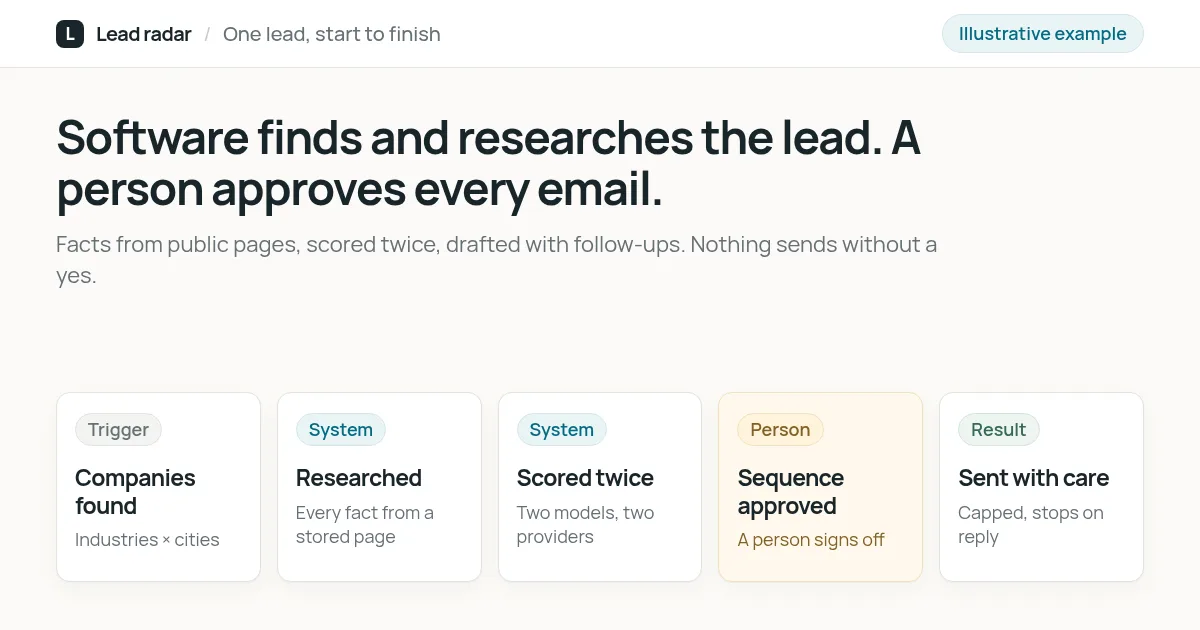
This is the system that finds and contacts new clients for Lindevo. Every week it looks for companies in the Baltics that could use what we build, reads their public websites, scores how good a fit they are and drafts a short personal email with follow-ups. A person approves every sequence before a single email leaves, and the system stops on its own when someone replies. We built it for our own sales, and we set up the same kind of pipeline for clients.
What it does for us
Finding new clients is steady, unglamorous work: search for companies, read their websites, decide who is worth contacting, write to each one personally, remember to follow up. It is easy to start and easy to let slide. The radar keeps it going every week:
- A steady list of fitting companies. New candidates arrive each week by industry and city, already researched and scored.
- The reasoning is on the page. Each lead shows what we found on their site, why it scored as it did and which pages that came from.
- Emails worth sending. Drafts are short and specific to the company, written from what the research found, not from a template with the name swapped.
- Nothing falls through. Follow-ups go out on schedule, replies stop the sequence, and the whole pipeline sits in one place instead of across inboxes and spreadsheets.
How the lead radar works
Click through the steps one lead goes through. The screens are simplified illustrations with example data.
Trigger
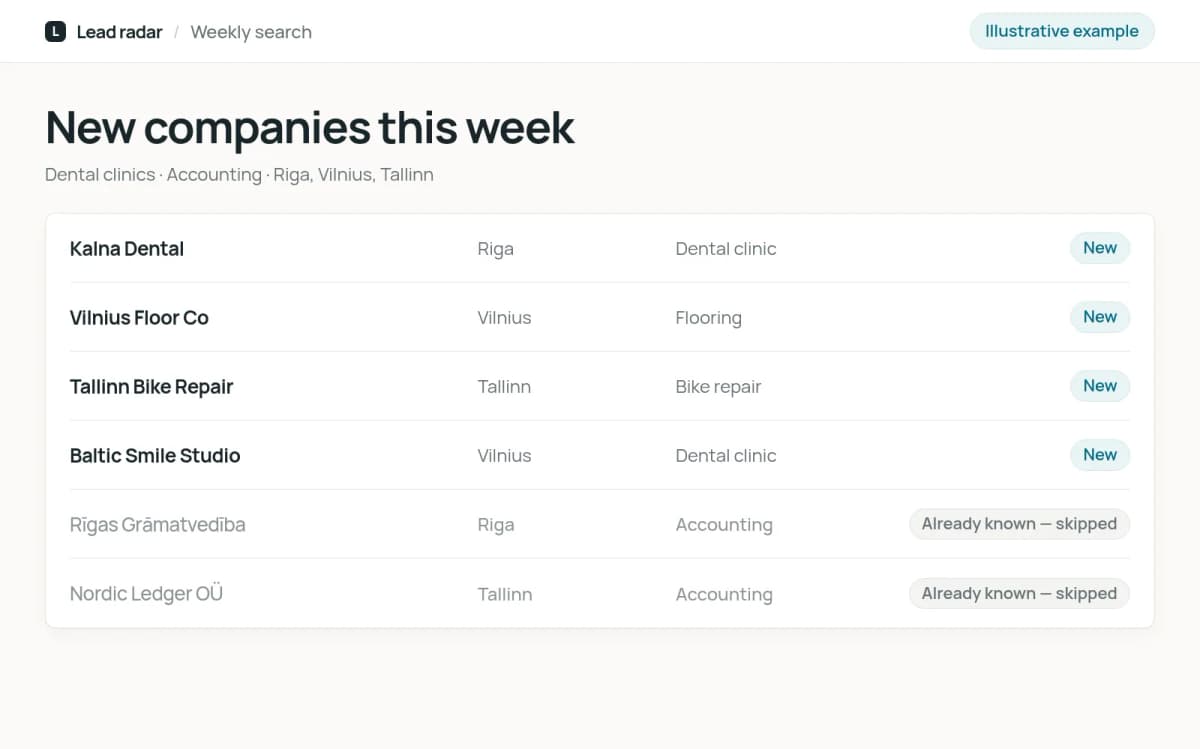
Companies found
Each week the radar searches a rotating set of industries and cities in Latvia, Lithuania and Estonia. Companies we already know are removed, and the rest become new leads. A person can also add a company by hand.
Prepared by the system
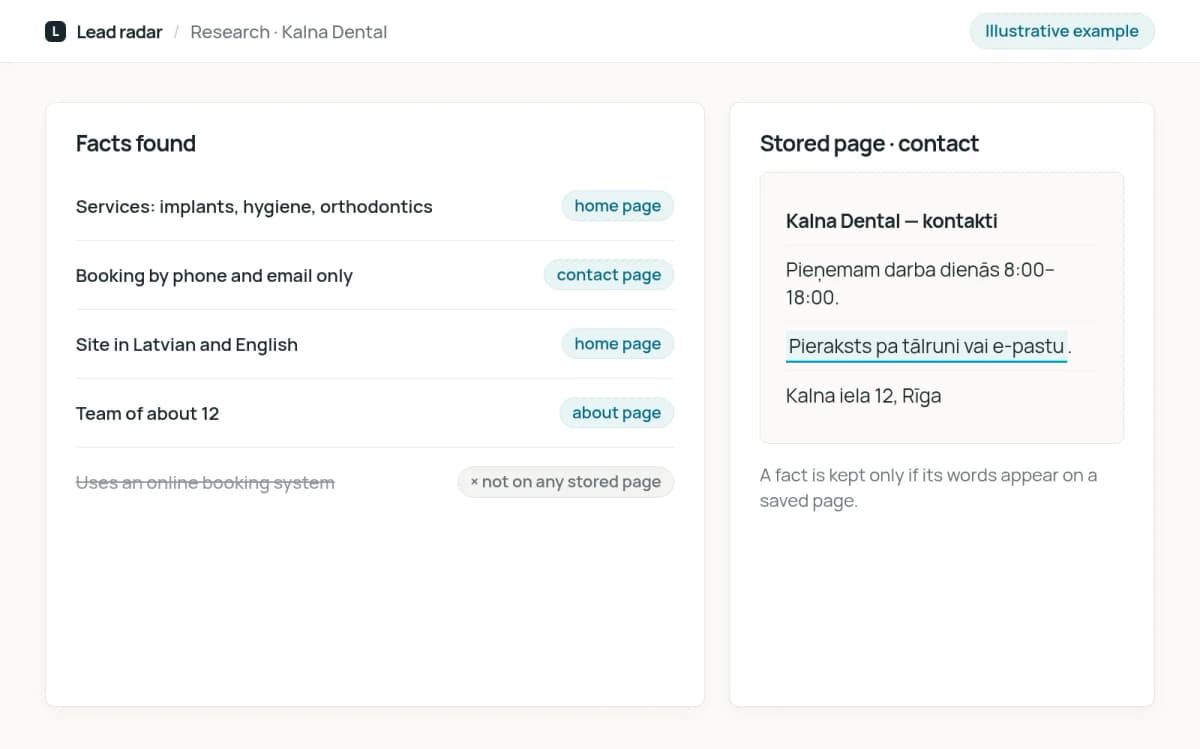
Research from public pages
Code checks the company's website, reads its home, contact and about pages, and stores what it found. An AI model then pulls out facts such as services, languages and signs of manual work. A fact is kept only if the stored page actually contains it.
Prepared by the system
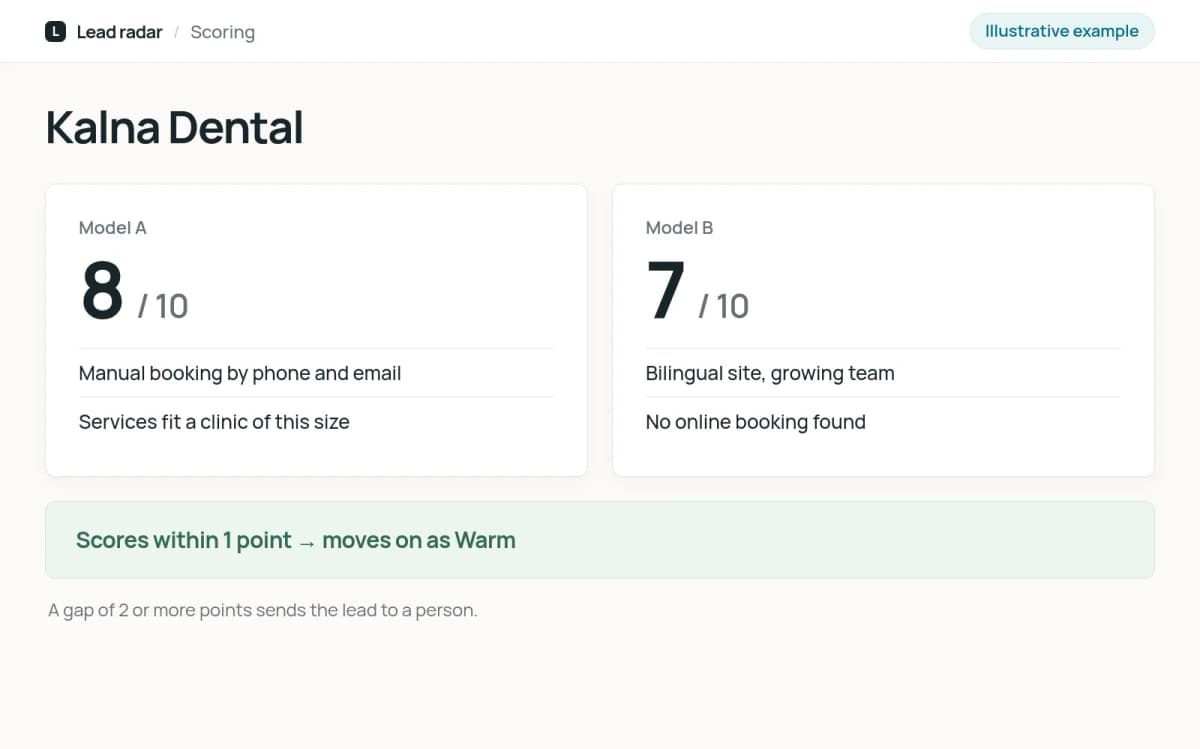
Scored twice
One model scores the lead against our description of a good client, and a second model from a different provider scores it again. If they agree, the lead moves on as hot, warm or cold. If they are two or more points apart, or something rules the company out, it goes to a person.
Prepared by the system
Email and follow-ups drafted
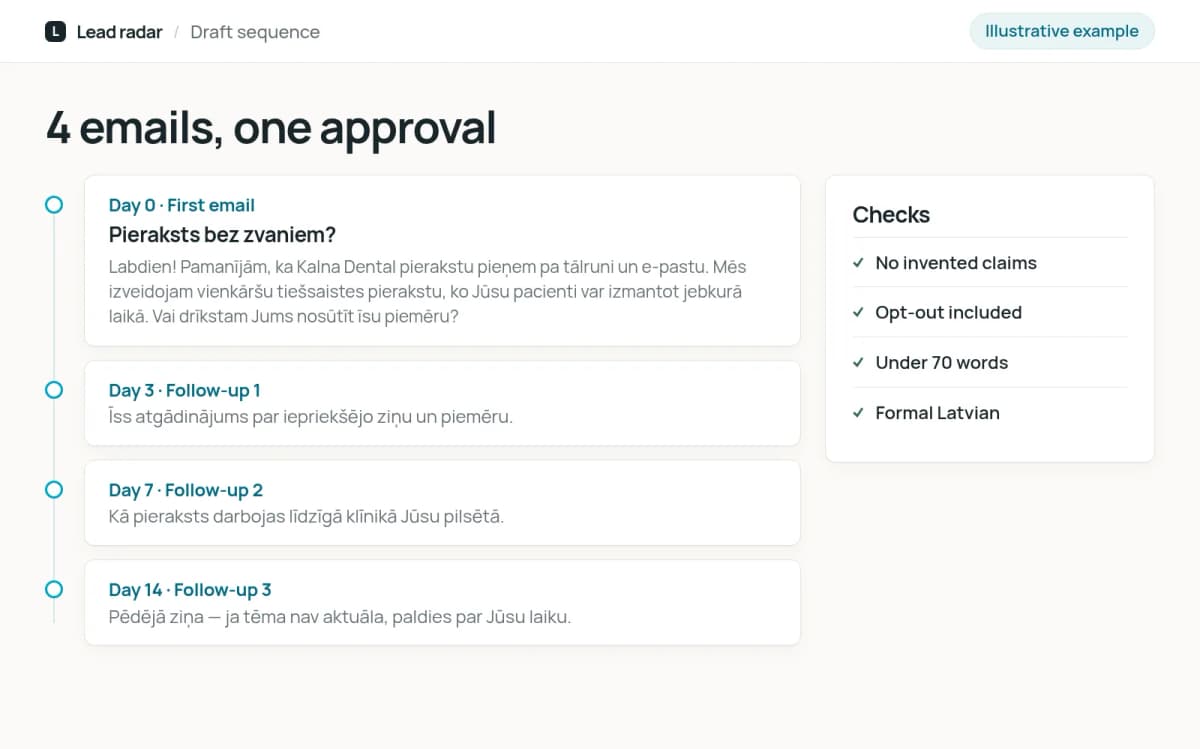
For good fits the system drafts a short first email and up to three follow-ups, written from what the research found. A separate check looks for anything that should not be there, such as an invented claim, a missing opt-out or an overlong text.
Checked by a person
A person approves the sequence
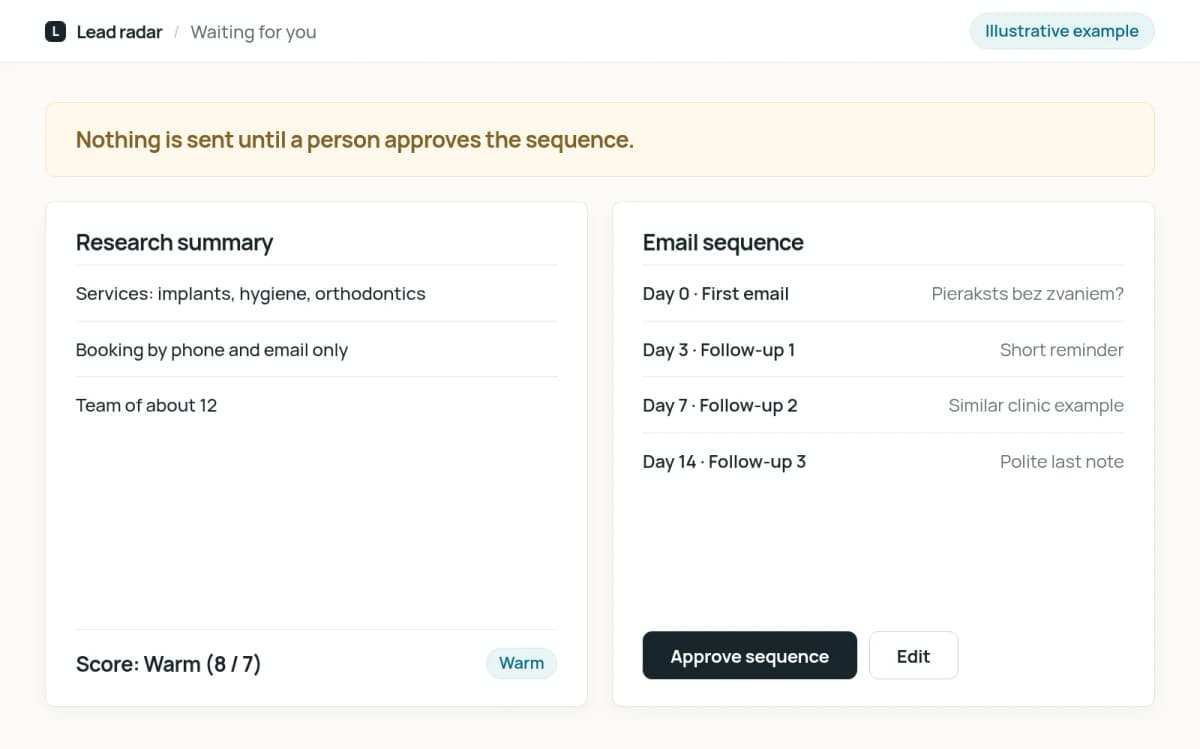
A person reads the lead's research next to the emails, edits them if needed and approves the sequence. If anything in an approved email changes afterwards without a person doing it, the approval is withdrawn.
Result
Sent with care, stopped on reply
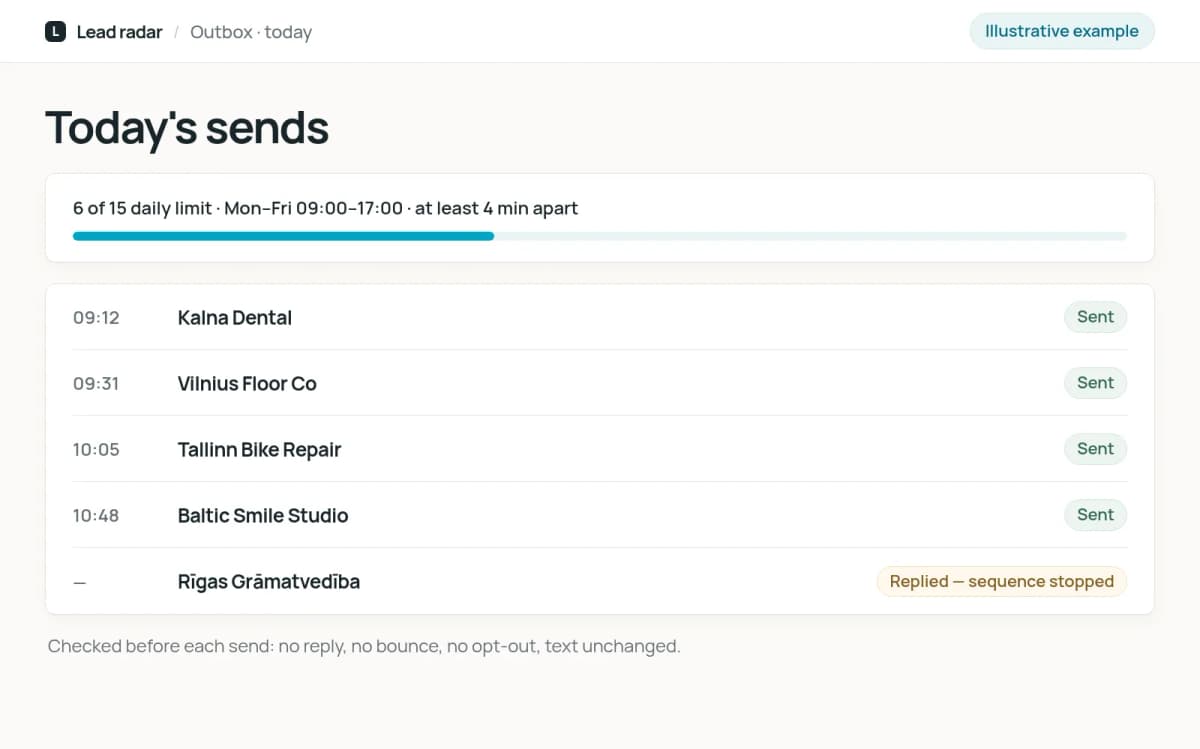
Approved emails go out from our own mailbox, a few a day, in working hours. Before each send the system checks again: no reply in the thread, no bounce, no opt-out, the text unchanged. A reply stops the sequence and lands with a person.
A person approves every email
Nothing is sent until a person has approved the sequence. Approval covers the exact text that was approved: if an email changes later and a person did not make the change, it goes back to draft.
The send itself is built so that one email can never go out twice. Before contacting the mailbox, the system records that it is about to send. If something breaks mid-way, the next run checks the sent folder instead of trying again. When it cannot tell whether an email went out, it assumes it did and asks a person.
Sending also has hard limits. There is a daily cap, a send window on working days, a gap of several minutes between emails, and one switch that stops all sending at once.
What we learned
Our first version used AI agents that searched, browsed and wrote on their own. It worked, but an agent with free rein will sometimes fill a gap with something that sounds right, and once one gave a lead a website that did not exist. The fix was to split the work: code gathers every fact and stores the page it came from, and the AI only extracts, scores and writes from that stored evidence. It costs a little flexibility and buys facts we can check.
What it could do for your business
A lead radar for your market. We set it up around your description of a good client, the industries and regions you sell to, and your own mailbox. Your salesperson stays the one who approves: the system researches and drafts, they decide who hears from you.
The same pattern for other outbound work. The structure fits wherever software can prepare a personal message from facts and a person should sign off: renewal reminders, partner outreach, follow-ups after a quote. Read how we build reliable AI workflows with human review.
What it does not do
- It does not send anything a person has not approved.
- It does not invent facts about a company. Every detail comes from a page we stored and can show.
- It does not send in bulk. Volume is capped, and every email is written for one company.
- It does not keep writing to someone who replied, bounced or asked to stop.
Frequently asked questions
Is this spam?
No. It contacts a small number of businesses a day, each with an email written for that company from its own public information, from a real mailbox a person reads. Every email has a clear way to opt out, and an opt-out stops all further contact.
Where do the leads come from?
From public business listings and the companies' own websites. The radar only uses public information, and it keeps the page each fact came from so a person can check it.
Can it write in Latvian and other languages?
Yes. Our outreach is in Latvian and English, and the language follows the company. Other languages can be added per project.
Can you build one for our sales team?
Yes. We start with who your best clients are, where you sell and who on your team will approve the emails, then set up the radar around them. Tell us about your sales process and we will suggest a first step.