

An AI system is more than a chatbot
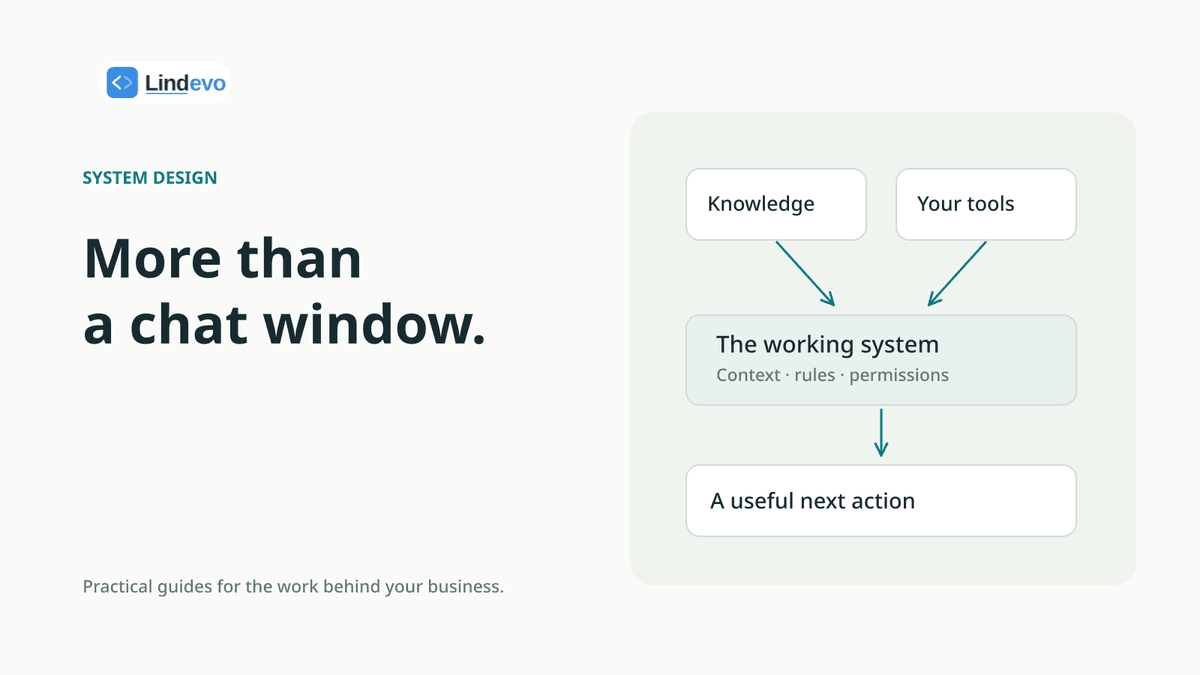
A chat window can answer a question. A business process usually needs more: the right customer record, current information, permission to act and a clear owner when something goes wrong.
The difference matters when you are deciding what to buy or build. You may need a better way to search documents, a workflow that prepares recurring work, or an application that helps a team handle exceptions. A chatbot can be part of any of them.
Separate the interface from the work
In this guide, “chatbot” means a conversational interface. “AI system” means the complete arrangement that makes AI useful for a business task: its information, integrations, rules, people and ongoing operation. These are working definitions, not universal product categories.
A chatbot can have sophisticated integrations. An AI system can run without a chat window at all. The useful question is what happens before and after the model generates a response.
| Question | What to look for |
|---|---|
| Where does the information come from? | Named sources with ownership and access rules |
| How does the work start? | A message, a scheduled task or an event in an existing tool |
| What does it produce? | A draft, structured record, decision aid or permitted action |
| Who checks it? | Clear approval rules and an accountable reviewer where needed |
| What if it cannot finish? | An exception path that reaches the right person |
| What happens tomorrow? | Monitoring, source updates and a way to report problems |
Use this table when discussing a proposal. A polished demonstration should make these answers easier to understand, not replace them.
Follow one customer enquiry
Imagine a customer asks whether a service is available next Thursday and whether an old quotation still applies. This is an illustrative workflow; it does not describe a deployed client system.
A useful reply depends on information from several places. The customer needs to be matched to the right account. Availability must come from a current source. The quotation may have expired. A standard service guide may explain the service but say nothing about this customer's agreed terms.
The workflow receives the enquiry and looks for a reliable account match. If two customers share a name, it asks for clarification or sends the match to a reviewer instead of guessing.
It retrieves the relevant quotation, current service details and availability. Access should be limited to what this workflow is allowed to use.
The system checks expiry dates and required fields. A request to extend an expired quotation is routed to the person who can approve it.
It drafts the reply and shows the supporting information. It should identify what it could not establish as clearly as what it found.
The authorised person reviews the draft. If sending and record updates are in scope, the workflow records their outcome and handles a failed update without silently claiming completion.
The language model helps interpret the enquiry and prepare the wording. The surrounding application decides which records it can access, validates important fields and enforces the allowed actions.
Connected knowledge is more than uploading files
Retrieval can help a model work with information from an external collection. For example, OpenAI's file-search tool can search uploaded knowledge and provide file citations. That is one implementation option, not a requirement to use that provider. See the file-search documentation.
Retrieval does not settle whether a document is current, whether it applies to this customer or whether the user should be allowed to see it. Those questions need explicit handling in the application and the source process.
For a service guide, agree an owner, a review date and a way to retire old versions. For a customer-specific document, enforce access to the relevant account. For live availability, decide how recently the information must be checked before making a commitment.
A citation is helpful because someone can inspect the evidence. It is not proof that the answer correctly interpreted that evidence.
An agent is a choice about control
You may also hear the word “agent.” The term is used differently across products. Anthropic distinguishes predefined workflows from agents that dynamically choose their process and tools. Its explanation is a useful way to discuss how much freedom a particular task needs.
For a fixed enquiry process, a predictable sequence may be sufficient. A more open-ended research task may benefit from choosing the next step dynamically. More freedom also creates more possible paths to test and operate.
Ask the supplier to show where the model makes a choice and where ordinary software enforces a rule. The label on the product tells you less than that boundary.
Human review needs a place in the design
“A person can check it” leaves several questions unanswered. Where is the draft? Who receives it? What evidence can they inspect? What happens if nobody responds? Can they correct the customer match as well as the wording?
Info
Make the review actionable. Put the proposed action, relevant sources, unresolved questions and approve-or-edit controls together. A reviewer should not have to reconstruct the entire task to make a decision.
Not every action needs the same approval. Adding an internal tag and sending a contractual commitment have different consequences. Agree the permissions for each action, then enforce them outside the model's instructions.
What to ask for in a proposal
Ask for a concrete input-to-outcome example, a list of connected sources, the approval boundaries, the treatment of failures and the ownership after launch. Also ask how you will test the result before relying on it and how the team can pause it.
If all you need is occasional help drafting text, an existing tool may be enough. If your team repeatedly gathers the same context and moves work between systems, a connected workflow may deserve a closer look.
Lindevo's services cover company knowledge, connected workflows and internal tools. To narrow the first piece of work, start with choosing your first AI automation.
On this page